- Fire
- Commercial
- Blog
Mineral Wool Wall Insulation & Fire Safety
Enhancing Fire Safety within Commercial Walls with Mineral Wool Wall Insulation
Fire safety is one of the most critical considerations in commercial building design. Modern wall enclosure systems must balance multiple demands, from aesthetics and durability to energy efficiency and acoustic performance. Among these demands, fire performance should also be a high priority. Mineral wool wall insulation is integral to these fire-resisting systems.
A Brief History of Fire Prevention in Buildings
The importance of modern building fire protection has evolved over time. After the Great Chicago Fire of 1871 killed more than 250 people and left 100,000 homeless, the National Fire Protection Association (NFPA) launched Fire Prevention Week in 1922 to bring awareness to fire safety methods and prevention techniques. Because the Great Chicago Fire began on October 8, 1871, Fire Prevention Week is observed each year during the week of October 9th. In 1925, President Calvin Coolidge declared fire prevention week a national observance, making it the longest-running public health campaign in the United States. Fire Prevention Week, and the broader observance of Fire Prevention Month, are still recognized every October, nearly a century later. Its message is clear: fires can devastate communities, but education and prevention save lives. This same principle guides today’s commercial building insulation industry.
Mineral wool wall insulation plays an essential role in modern building fire safety. Fire-resistant mineral wool insulation is widely used in perimeter fire containment systems and commercial wall assemblies, helping projects comply with strict codes and achieve proven fire ratings. In addition to its thermal wall insulation performance, mineral wool insulation’s benefits include contributing to resilient buildings.
What Are Commercial Wall Enclosure Systems?
The exterior wall of a commercial building can be defined as the enclosure system. Ultimately, the exterior wall is designed with durability, performance, fire safety, and occupant comfort in mind.
What Are the Main Components of Wall Enclosure Systems?
The main parts of wall enclosure systems are the structure, insulation, the outer surface or cladding, and layers that block air and water. Different exterior walls have slightly different elements.
- High Rise Construction: In high-rise construction, aluminum-framed curtain walls are common. These systems include the aluminum framing, anchors that attach the wall to the floor slab, and a spandrel area that conceals structural elements. Spandrels can be made from glass, metal, stone, or aluminum panels; they are the areas where the insulation is installed for thermal and fire performance. A vapor barrier may also be installed in this space to control moisture. This can take the form of a galvanized steel back pan or a foil-faced insulation product that provides an appropriate perm rating for the wall system. To ensure performance, the barrier must remain continuous, with edges sealed around the perimeter of the spandrel framing.
- Low to Mid-Rise Buildings: In low- to mid-rise buildings, wall systems may be built with steel or wood framing, CMU, or precast substrates. Facades can include EIFS, stucco, ACM, MCM, HPL, or terracotta. These systems often introduce combustible elements such as foam plastic insulation or certain air barriers, which must be carefully evaluated for fire safety.
No matter what type of building or enclosure system is used, fire safety remains a priority. This is where perimeter fire containment systems and continuous insulation systems come into play, depending on the exterior wall construction. These systems help allow more time to escape and for first responders to enter during a fire.
Perimeter Fire Containment Systems in Commercial Buildings
Perimeter fire containment systems are passive fire protection assemblies designed to close the gap between a fire-rated floor and the non-rated exterior curtain wall. Without this protection, fire and smoke can travel through that opening and spread quickly from one floor to the next.
Though that narrow gap may look minor, it is one of the most vulnerable parts of a wall enclosure. If left unprotected, flames bypass the rated floor slab and compromise the entire building. A properly installed perimeter fire containment system helps hold fire to the room of origin, allowing occupants additional time to evacuate and giving firefighters a window to respond.
How Do Perimeter Fire Containment Systems Work?
The International Building Code (IBC) states that where a fire resistance-rated floor or floor/ceiling assemblies are required, the void created at the intersection of the non-rated exterior curtain wall assemblies and the floor assembly must be sealed with an approved system to help prevent the interior spread of fire. These systems combine several elements to keep the joint sealed under fire conditions:
- tested and proven mineral wool insulation [that has been tested in a full-scale E2307 fire test]
- mechanical attachments
- ASTM E2307 tested mineral wool framing covers
- smoke seals
- back reinforcement members
Together, these components help prevent the insulation from falling out or degrading as the curtain wall deforms under heat. Systems are tested to ASTM E2307, which measures their ability to stop flames and hot gases from passing through the joint for as long as the fire rating of the floor assembly.
Where are Perimeter Fire Containment Systems Most Critical?
Perimeter fire containment systems are required wherever a fire-rated floor meets a non-rated exterior wall, but they are especially important in buildings over three stories. High-rise towers, hospitals, and residential complexes carry higher risks because evacuation takes longer and firefighting access is limited. In these structures, proper containment can make a critical difference in preventing vertical fire spread, including if the exterior wall is tested to ASTM E2874, it can prevent leapfrog fire propagation.
How Mineral Wool Fits Into Perimeter Fire Containment Systems
In perimeter fire containment systems, insulation plays a critical role. Mineral wool firestopping products are always specified in these assemblies because they help maintain a continuous barrier at the floor-to-wall joint, improving both fire safety and system performance. Curtain wall components such as aluminum framing, anchors, and glass can fail within minutes when exposed to fire. Mineral wool insulation is non-combustible and engineered to maintain integrity under high temperatures, helping protect these vulnerable areas.
Not all mineral wool products are the same, which is why testing and certification are essential to review that the material performs as required for fire safety and long-term reliability. Fire-resistant mineral wool insulation must have the correct density, thickness, and fire performance characteristics to meet ASTM E2307 requirements and provide reliable fire protection.
Thermal Insulation Performance & Fire Safety Standards
Standard fire tests, such as ASTM E119, show how different building materials respond to high temperatures over time. ASTM E119 is a test method that is used to evaluate how various types of building elements perform when exposed to fire for a predetermined time. ASTM E119 is a vital test for evaluating building materials and components. However, this test only tests fire exposure on one side of the assembly. For perimeter fire containment systems, the correct ASTM standard to reference is ASTM E2307, as ASTM E2307 subjects the system to a much more onerous fire exposure, simultaneously, on both sides of the assembly.
Mineral Wool & Fire Ratings
Mineral wool systems have demonstrated the ability to remain intact at temperatures above 2,000°F with 2-3 hour fire resistance ratings. When evaluated according to ASTM E2307, the test method is specifically designed for determining the hourly rating of perimeter fire containment. ASTM E2307 tested mineral wool insulation has demonstrated its ability to help protect a portion of the exterior wall and provide a barrier at the interior floor joint under fire exposure. These results confirm mineral wool fire ratings established through testing, giving designers confidence that the insulation will perform under demanding fire conditions.
What is an F-Rating?
An F-rating is the fire-resistance rating given for determining the fire resistance of perimeter fire containment systems. The F-rating measures the ability of the design to prevent flame and hot gases from passing through the interior of the system between the edge of the slab and the interior face of the curtain wall.
For those less familiar with fire testing, an F-rating is essentially the “time score” for how long a system can hold back fire at a critical joint. In real-world conditions, this means an F-rating indicates whether fire can be held at the building’s perimeter for two or three hours, depending on the system. That extra time allows more occupants to escape and gives first responders a safer opportunity to control the fire.
Building Codes & Certification
The International Building Code (IBC) requires that where fire resistance-rated floors meet the non-rated exterior wall, the void at the perimeter must be sealed with an approved system to prevent fire spread between floors. These systems must be tested to ASTM E2307 and achieve an F-rating equal to or greater than the floor assembly’s fire-resistance rating. Independent labs such as UL and Intertek certify perimeter fire containment systems, verifying that systems containing mineral wool insulation meet code requirements and maintain performance under fire exposure.
IBC Chapter 7 is the section of the code that addresses fire and smoke protection features in buildings. It establishes requirements for assemblies such as fire barriers, floor systems, and perimeter joints to ensure continuity of fire resistance. Over time, updates to this chapter have occasionally introduced exceptions that reduce the strength of these requirements, often in favor of active systems such as sprinklers. While sprinklers are essential for life safety, redundancy is critical because passive systems, like perimeter fire containment, provide backup protection if active systems fail.
Another necessary standard is NFPA (National Fire Protection Association) 285, which applies when continuous insulation (CI) products with combustible materials are used in exterior walls. NFPA 285 evaluates whether flames can spread over or through the wall assembly when exposed to fire on the building’s exterior. Using non-combustible mineral wool as continuous insulation reduces this risk and supports compliance with NFPA 285.
Why Fire-Resistant Mineral Wool Insulation is So Critical in Perimeter Fire Containment Systems
Fire safety experts have raised concerns about imported mineral wool products entering the market without being tested to a full scale ASTM E2307 testing. While sometimes marketed as lower-cost alternatives, mineral wool products that have not been tested within a system to ASTM E2307may not comply with the IBC and could pose risks if used in perimeter fire containment systems.
In recent years, prefabricated curtain wall panels with uncertified mineral wool have entered the U.S. market. In some cases, mineral wool insulation not tested to ASTM E2307 was only discovered after installation, forcing expensive rework to replace it with ASTM E2307-tested products. This risk can be avoided by requiring UL- or Intertek-certified mineral wool insulation that has been tested in an ASTM E2307 system. Clear labeling and approved installation practices provide confidence that perimeter fire containment systems will perform as required.
Design Choices for Perimeter Fire Containment Systems
The effectiveness of a perimeter fire containment system is not only about the choice of materials but also how the system is designed and installed. There are six critical design criteria that must be considered for long-term fire safety: using ASTM E2307 tested mineral wool in the spandrel, securing it with mechanical attachments that can withstand fire conditions, reinforcing insulation to maintain a tight seal, properly compressing ASTM E2307 tested mineral wool safing in the interior joint, protecting vulnerable aluminum framing with ASTM E2307 tested mineral wool mullion covers, and applying a smoke seal to help prevent smoke migration.
Each of these steps is essential to meeting ASTM E2307 requirements, so the system performs as intended. When these details are overlooked or substituted, fire safety is compromised. When they are followed, mineral wool insulation helps create perimeter fire containment systems.
When selecting a perimeter fire containment system, the first step is to choose a tested and listed design that closely matches the project's conditions. This basis of design is essential because it establishes compliance and performance expectations, even if it doesn’t match every project detail. Since most projects involve elements with special conditions, such as short spandrels, curved curtain walls, or exposed anchors, engineering judgments (EJs) are often required to bridge the gaps. An EJ applies additional test data and experience to adjust a design while maintaining code compliance and fire safety.
The Future of Fire Prevention with Commercial Wall Insulation
The future of commercial wall insulation will be defined by innovation. From engineered and tested solutions that adapt systems to unique designs to sustainable products that support green building goals, innovation will be a key factor alongside an enduring focus on fire prevention and life safety.
Thermafiber®, the pioneer of perimeter fire containment, continues to be a leader in this area with one of the most extensive libraries of tested and listed systems in the industry. By innovating and testing specific exterior wall designs and supporting project conditions with engineering judgments from the Thermafiber Insolutions team, architects and contractors can streamline the specification process while maintaining compliance and fire safety.
Innovation Through Engineering Judgments
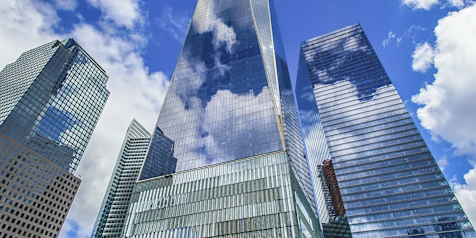
Through engineering judgments, perimeter fire containment assemblies can be adapted to address unique project conditions without compromising performance. Nearly every building design introduces conditions that do not match tested systems. In these cases, firestop manufacturers collaborate with curtain wall teams to adapt approved designs while maintaining compliance and fire performance. A prominent example is One World Trade Center, where Owens Corning’s Thermafiber® engineering team developed custom solutions to address unique curtain wall geometry, floor-to-floor vision glass, and wet mullion systems. By analyzing each level of the 104-story structure, the team’s assessment was critical to helping confirm that the perimeter fire containment system would perform effectively under fire exposure. Thermafiber® products are also the only mineral wool insulation to receive the Department of Homeland Security’s Safety Act designation, underscoring their recognized role in supporting life safety. Projects like this demonstrate how engineering solutions extend protection to even the most complex building designs.
Innovation in Sustainability
Owens Corning introduced a formaldehyde-free version of its Thermafiber® mineral wool insulation, giving architects a way to meet both fire safety and green building certifications. Thermafiber® mineral wood products can be used in LEED projects. The company also launched North America’s first formaldehyde-free perimeter fire containment system for aluminum and steel-framed curtain walls. Tested to ASTM E2307 and compliant with the International Building Code, mineral wool insulation within specific systems provides an F-rating of two hours in standard configurations and up to three hours in select perimeter fire containment system designs. By maintaining fire resistance while delivering high thermal performance, formaldehyde-free mineral wool supports LEED certification and other green building objectives without compromising safety.
Continued Innovation in Fire Safety
As we are reminded every October, there are still lessons to uphold and fire safety standards to follow to prevent tragedies from fire loss. The same message that inspired these observances nearly a century ago still applies today: education, innovation, and prevention save lives. For the commercial building industry, this prevention includes building systems that combine thoughtful design, energy efficiency, and proven materials, like mineral wool wall insulation, to advance fire safety for future generations.
References:
- Commercial Walls
- Thermafiber Mineral Wool
- History of Fire Prevention Week from NFPA (National Fire Prevention Association)
- OC Perimeter Fire Containment
- ASTM International page on ASTM E119
- ASTM International page on ASTM 2307
- 2024 International Building Code (ICC IBC-2024) from the American National Standards Institute (ANSI)
- IBC Chapter 7 - Fire & Smoke Protection Features
- NFPA 285 Standard Development from NFPA
- Thermafiber PFC Selector
- Thermafiber Engineering Judgments
- One World Trade Center Case Study
- Understanding the SAFETY Act
- Thermafiber® Formaldehyde-Free Insulation
- OC Press Release for First Formaldehyde-Free Perimeter Fire Containment System in North America
- FAQs About Thermafiber® Mineral Wool Insulation
- OC Curtain Wall CW-D-1014 Through 1017 Formaldehyde-Free
- Navigating Six Special Conditions in Perimeter Fire Containment System Design
Related Articles
Related Articles
Fire • Commercial • BlogMineral Wool Wall Insulation & Fire Safety
Fire • Commercial • BlogStone Wool Versus Slag Wool Insulation
Fire • Industrial • WebinarLNG Pool Fire Suppression & Cryogenic Liquid Spill Protection
Fire • Commercial • BlogThermafiber®, the Workhorse in Perimeter Fire Containment, Celebrates 90 Years
Fire • Commercial • BlogFAQs About Thermafiber® Mineral Wool Insulation
Fire • Industrial • BlogCombustible Liquids in Insulation
Thermal • Industrial • BlogKEY CONSIDERATIONS IN DESIGNING DIRECT BURIAL INSULATION SYSTEMS
Fire • Industrial • BlogThe Behavior of Industrial Insulation in Case of Fire
Fire • Industrial • WebinarPassive Fire Protection Systems Webinar
Fire • Industrial • BlogMitigating LNG pool fires using passive systems
Fire • Industrial • BlogFire testing takeaways to consider when selecting insulation for fire protection
Fire • Commercial • BlogBalancing life safety, installation efficiency and design flexibility
Fire • Commercial • BlogNavigating Six Special Conditions in Perimeter Fire Containment System Design
Thermal • Mechanical • BlogLabor saving features to reduce pipe insulation installation time
Fire • Mechanical • BlogProtecting life safety in plenum spaces
Fire • Commercial • BlogDismantling 5 Common Perimeter Fire Containment Misconceptions
Fire • Commercial • Blog3 Components of Fire Protection for Balanced Life Safety
Fire • Commercial • BlogSix Critical Components of a Listed Perimeter Fire Containment Assembly
Fire • Commercial • BlogUnderstanding the SAFETY Act: Using perimeter fire containment systems to reduce liability
Fire • Commercial • BlogSix Critical Components of Engineering Judgments for PFC Systems
Jump to a Solution Suite
Jump to a Solution Suite