










This is a cache of https://www.owenscorning.com/en-us/roofing/install-instructions/proedge. It is a snapshot of the page as it appeared on 2026-02-02T03:55:36.577+0000.
ProEdge® Hip & Ridge Shingles Installation Instructions | Owens Corning Roofing
Skip to main content

CAUTION: DO NOT MIX MATERIAL BEARING DIFFERENT LOT NUMBERS, REFER TO THE LOT NUMBERS LOCATED ON THE SIDE OF THE BUNDLE.

Complete shingle application on roof deck before applying hip and ridge shingles. Hip shingles must be applied before ridge shingles.

Note: If a new roof is being applied over an existing roof, remove the old hip and ridge shingles to obtain a level application. Each shingle is perforated for separation into three hip & ridge shingles.

Precautionary Notes:

The manufacturer will not be responsible for problems resulting from any deviation from the recommended application instructions and the following precautions.

Handling: Use extra care in handling shingles when the temperature is below 40°F (5°C). DO NOT drop bundles. Shingles can be broken easily in cold weather or their edges damaged in hot weather. DO NOT attempt to separate shingles by “breaking” them over another object such as a ridge.

Fastener requirement: Use galvanized steel, stainless steel, or aluminum nails minimum 12 gauge shank with 3/8” diameter head. Owens Corning™ recommends that fasteners comply with ASTM F 1667. Check local building codes. All fasteners must penetrate at least 3/4” into the wood deck or completely through plywood or OSB sheathing.

Fastening: Drive all fasteners until they are flush with the surface of the shingle. Special care must be taken when using pneumatic nail guns. Nails are to be driven straight so the entire head is flush against the shingle but does not cut the shingle surface. An improperly adjusted pneumatic gun can result in raised fasteners causing sealing failure, raised tabs, leaks, or blow-off. Do not apply fasteners in the sealant strip.

Storage: Store in a covered, ventilated area at a maximum temperature of 110°F (43°C). Stack in a flat fashion (maximum of 24 bundles high). Protect shingles from weather when stored at the job site. Do not store near steam pipes, radiators, etc.

All exposed material must be rated Class A by Underwriters Laboratories, to maintain a Class A system.

Hip & Ridge Application

  1. Separate each piece of ProEdge® hip & ridge shingles into three individual shingles at the perforations.
  2. Create a starter shingle by removing the 6 inch exposure portion of the shingle.
  3. Beginning at the bottom of each hip or the end of the ridge opposite the prevailing wind direction, install the starter shingle using 1 fastener on each side, 1 inch from the side edge and 1 ¼ inch from the cut end.
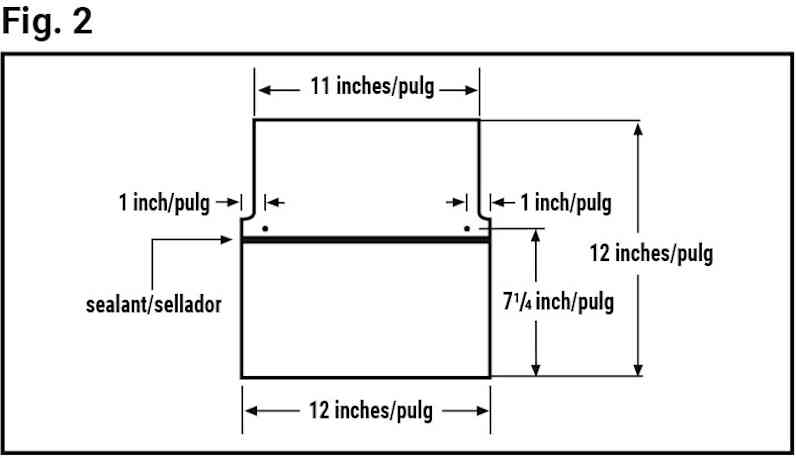
  4. Continue installing shingles up the hip or ridge by fastening each shingle with 1 fastener on each side, 1 inch from the side edge and 7 ¼ inches from the exposed end. See Figs. 1 & 2.
  5. Apply remaining hip and ridge shingles in the same manner with a 6 inch exposure.
  6. When finishing the ridge, leave no headlap portion of the last hip and ridge shingle exposed. One option is to use the 6 inch exposed portion of a hip and ridge shingle, cutting a piece the appropriate length to extend over the headlap portion of the shingle to the end of the ridge.
  7. Fasten final piece with two nails, each 1 inch in from the side edge and 1 inch in from the end of the ridge. Cover exposed fasteners with asphalt roof cement. Asphalt roof cement must meet ASTM D-4586 Type I or Type II (Asbestos Free).
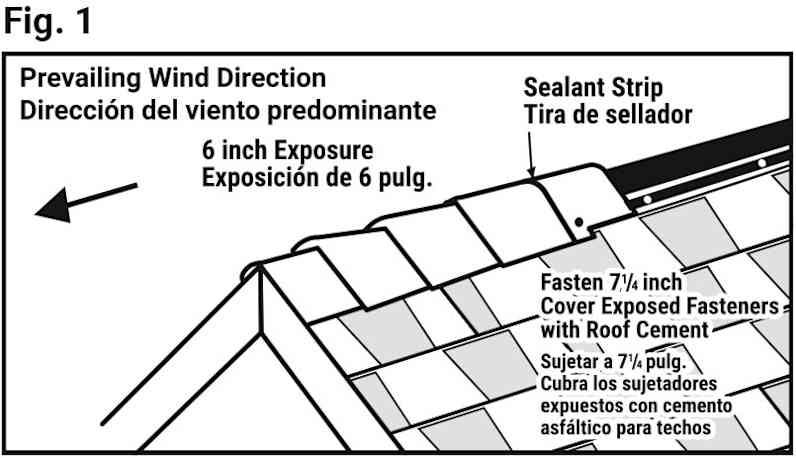
Fig 1
Fig 2

Alternative Fastening Patterns

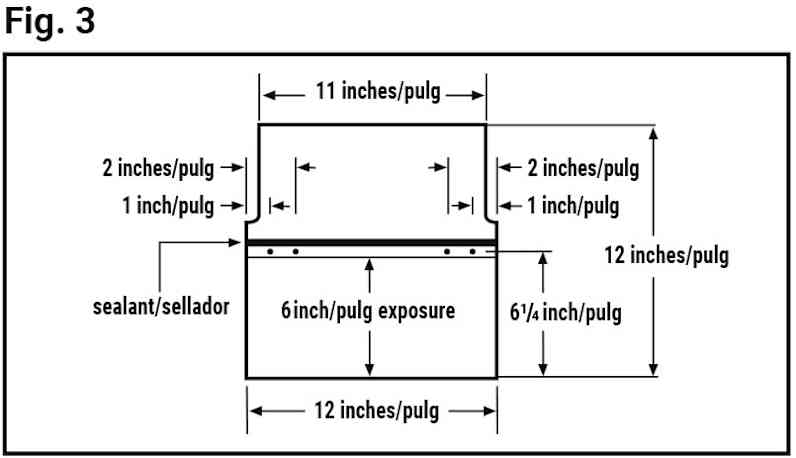
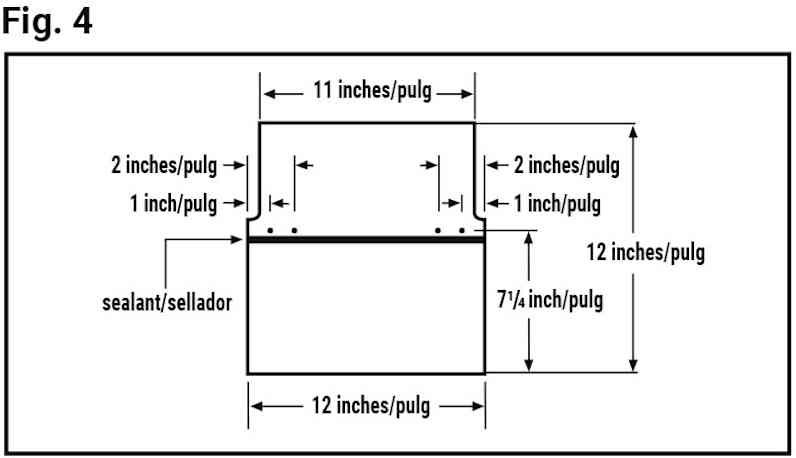
These products may also be fastened with 2 fasteners on each side, 1 and 2 inches from the side edge and 6 1/4 inches from the exposed end (See Fig. 3) OR with 2 fasteners on each side, 1 and 2 inches from the side edge and 7 1/4 inches from the exposed end (See Fig. 4).

Fig 3

Installing Double Hip & Ridge

Applying a double layer of shingles to hips or ridges is easy to do and creates a more aesthetically pleasing appearance. Simply install the shingles using the method described above, but fasten two shingles simultaneously — one on top of the other. Make sure fasteners are long enough to penetrate through both layers of shingle and completely through the roof deck.

Contact Us

Even though we’re a global company, we’re always ready to answer your questions. Call to speak with an Owens Corning representative.