
- Fire
- Commercial
- Blog
3 Components of Fire protection for Balanced Life Safety
Blog in Brief
Containing and extinguishing a fire in a high-rise structure as well as evacuating building occupants in an emergency presents several challenges. However, correctly designing and installing a combination of perimeter fire containment (PFC), which is considered passive fire containment, along with active and detective fire systems, helps improve safety and offsets some of the challenges in high-rise structures.
3 Components of Fire protection for Balanced Life Safety
Fire containment at the perimeter of a high-rise structure is probably one of the least understood and most complicated areas of fire protection.
There are three approaches to fire protection that can be used together to boost structure safety. These approaches include:
- Detective systems – like smoke alarms, or heat detectors, which identify a problem and notify occupants that there is a safety hazard.
- Suppression systems (active) – like automatic sprinkler systems, which respond to a problem. A system is considered “active” if it requires some form of activation to switch the system “on.” The system must turn on for it to work.
- Compartmentation (passive) – like fire-rated assemblies in the walls, floors and covering joints or fire doors – which, once correctly installed, are always in place to contain or slow the spread of fire and smoke. If properly installed, passive systems are designed to work. Passive systems help contain the fire to the room of origin, allowing occupants more time to evacuate the building and allowing fire personnel to enter the building to extinguish the fire.
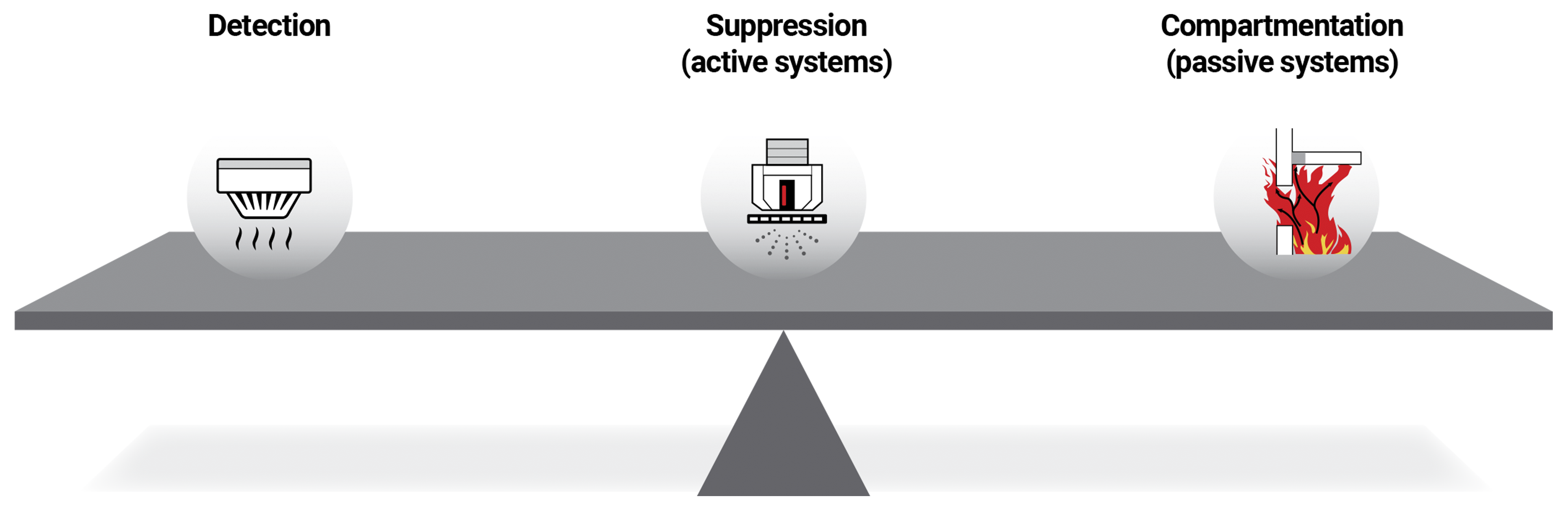
Real fire incidents have demonstrated that all three elements are needed to help protect the building and its occupants. When used together, they can provide a critical 2-3 hours to respond to the fire. In a high-rise building, that time provides the ability to escape and lets fire personnel to get in and attack the blaze.
Owens Corning® Thermafiber® has focused its work on the development of perimeter fire containment systems and has a legacy of life-safety focused efforts. This effort includes establishing a fire-rated test for PFCs and collecting a library of tested assemblies to help architects select components for PFC systems. We were a pioneer in the development of the perimeter fire containment system and worked with Underwriters Laboratories (UL®) to create an initial test standard used to evaluate assemblies. That work ultimately established the test standard ASTM E2307 – Standard test method for determining fire resistance of perimeter fire barriers using intermediate-scale, multi-story test apparatus.
Those involved in building code development and commercial building designers need to work together to confirm that safety systems are designed correctly to allow more time for occupants to escape a fire in tall structures.
Code requirements and fire inspections are needed to make sure that life safety systems are correctly installed. However, safety systems also need to have some flexibility to allow for creative designs while still proving protection. Architects need code-compliant systems that can be integrated into innovative designs to create atheistically pleasing buildings in the event of a catastrophic fire.

Jump to a Solution Suite
Jump to a Solution Suite